What you're looking at from the yard
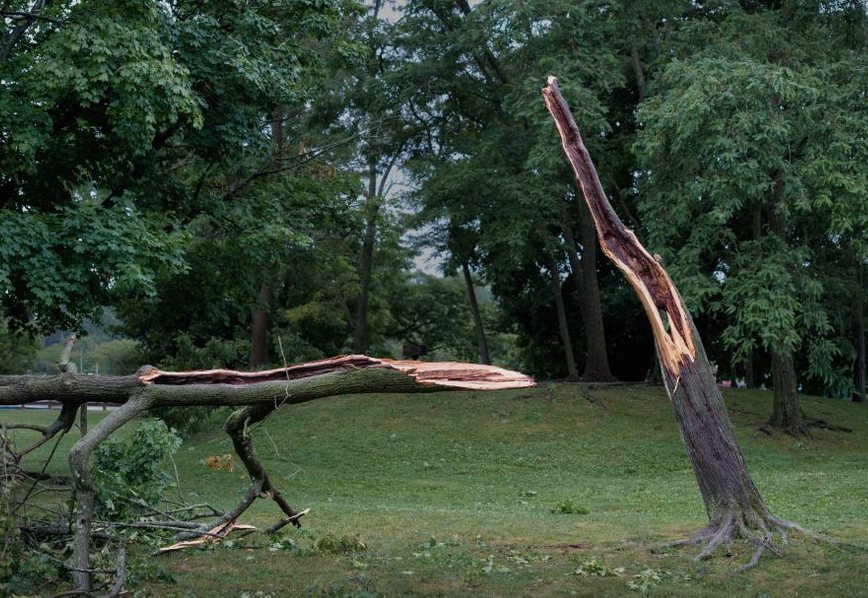
The tree that's already on the ground is the easy part. The stuff still overhead is what gets our attention: a limb hanging by a hinge of bark, a fork that's opened up, a strip of bark peeled off a trunk, a lean that wasn't there before the storm. If a tree is resting on a roof, a fence, or a car, don't climb up to inspect it. Keep people and animals back and call.
Check the ground too. Fresh soil pushed up on one side of the trunk, a crack in the turf, or a new gap between the trunk and the dirt means the tree is standing on very little and can go over without much help.
Snow here is light, about 7.1 inches a year with January the peak at roughly 2.9. A limb that lets go under a few inches of it was already weak. If the tree is still standing and nothing is on the house, waiting for daylight is usually fine. If a line is involved, don't wait, and don't get near it.
Why we walk the whole tree first
The limb that fell is often not the limb that failed. Before anyone touches a storm-damaged tree, we look at the whole thing: where the break starts, how far it runs, and whether the tree is still carrying its weight evenly on both sides.
Sometimes the trunk is sound and the branch was the only casualty. Sometimes the trunk is the problem and the branch was just the first thing to go. Those are two very different days, and the plan changes completely between them.
Direction, drop zone, and who's saying what
Before the first cut, we plan the job out loud: which way the tree goes, where the pieces land, who stands where, and what gets called out and by whom. On a healthy tree that's a short conversation. On a storm-damaged one it's the whole meeting, because the tree is already loaded and leaning, and the hinge you'd normally count on may be cracked through.
The drop zone is bigger than people expect. It's the swing of every limb, the roll a log takes once it hits the ground, and whatever sits behind the cut if it goes sideways. We clear that zone and keep it clear. Nobody stands in it, not for a photo, not for a phone call.
Signals are the other half. Two or three words, agreed on ahead of time, so the ground crew and the climber aren't guessing over a running saw.
Overhead lines decide how the job gets done
Any line overhead gets treated as energized, every time. That doesn't bend for a dead-looking wire or a line we've worked around a hundred times. There's a required clearance we have to keep, and if the tree can't be worked safely at that distance, we stop and call the utility. That call can add time to the job. It's still the call.
The climber stays tied in with a work-positioning lanyard the entire time they're off the ground, hard hat on, and the ground crew stays out from under the work. Storm trees move when you least expect it. A limb under tension can release in a direction nobody picked, and the trunk can shift once weight comes off it.
If a limb is resting on a line right now, leave it alone. Don't pull it, don't cut it, don't throw a rope over it. Call the utility first, then call us.
How It Works
-
Tell Us What You Need
A two-minute call is enough for us to understand the job and what it'll take.
-
Free On-Site Quote
We come out, look at the space, and confirm exactly what the job involves.
-
Clear, Written Price
You get the scope and the price in writing before any work starts. No surprises.
Some of what that looks like in the field:
- Plan the work, felling direction, drop zones, crew roles, and communication signals before cutting.
- Treat overhead power lines as energized and maintain required clearance; contact the utility if work cannot be done safely at that distance.
Typical Asheboro Pricing
Typical ranges, not a fixed price - the exact number is confirmed in writing before work starts.
$90–$1200
$200–$400
Straight Answers to Common Questions
Permit rules vary by city and tree species or size. Many municipalities require permits for trees above a certain diameter or protected species. Check local ordinances before work begins to avoid fines; the tree service can often advise on requirements.
Pruning costs range from $75 to $1,500. Late dormant season, just before spring growth, is often ideal because wounds close quickly and pests are inactive. Avoid trimming during leaf-out or fall color change when the tree is stressed.
The rule is a safety guideline: maintain a 5-foot exclusion zone around the sawyer, keep bystanders at least 15 feet away from the tree, and clear a 90-degree escape path opposite the planned fall direction. Proper planning reduces struck-by injuries.
Serving Asheboro and Nearby
Crews serve Asheboro, NC. Request an Estimate to confirm coverage for your address.
You Might Also Need
How We Do Business
- Free EstimatesThe first visit and our honest read cost you nothing.
- The same crew every visitYou get familiar faces, not whoever's free that day.
No-Pressure Estimates
Ready when you are, request a free estimate.
Estimates · No-pressure scheduling