Why people call us about planting
The reasons are consistent. A removal left a hole in the yard. A new build came with nothing but dirt and a couple of shrubs. Someone wants shade over a driveway or a window that takes the afternoon sun straight on. And sometimes we're called to replace a tree that never took, which is usually one that was too big for the hole, planted too deep, or never watered past the first month.
Anyone can dig a hole and drop a tree in it. Getting it to survive takes judgment, and it's cheaper to do it right once than to buy the same tree twice.
The tree has to fit the spot
Before anything gets picked, we look at the space at maturity, not at the size of the tree on the lot. How tall and how wide it ends up. How close that puts it to the house, the driveway, the foundation, and the lines overhead. Roots spread and trunks thicken, so a tree that looks fine in a nursery pot can become a problem if it goes in too close to a wall.
The weather here is part of the choice too. January lows average about 30 degrees and July highs about 88.5, a swing of roughly 58 degrees, and the tree has to take that every year. We won't name a species over the phone without knowing which way the site faces and how much sun it gets.
Bring us the spot: sun or shade, wet or dry corner, how much room there really is. Then we can talk about what belongs there.
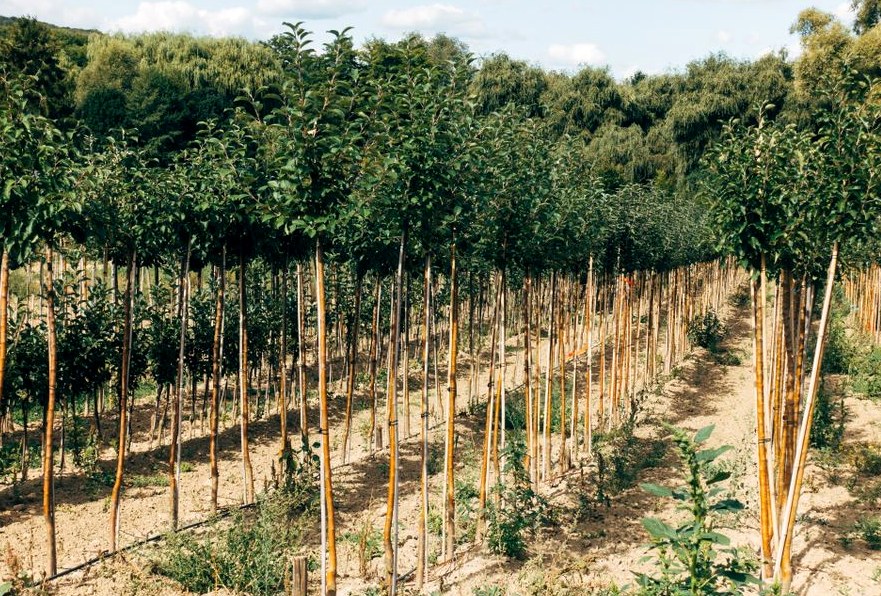
Planting day
The truck comes with the chainsaw and the mobile wood chipper, and they get used on planting jobs more than people expect. Something often has to come out first: a volunteer sapling in the way, a dead limb over the spot, brush that has to move before the tree can get from the truck to where it's going.
Then the hole. It's dug wide enough that the roots aren't fighting the sides, and to the right depth so the tree sits the way it grew, with the root flare at the surface. Planting too deep is a common way trees fail, and you can't fix it later by watering harder. We set the tree, backfill, water it in, and put a mulch ring around it that stays off the bark.
A big tree, a long carry from the street, several going in at once: that's the day.
Gear checks, and the work overhead
Sometimes planting means getting into a canopy first, to lift low limbs over a roof, a driveway, or a service drop. The rules are the same as any other day we climb. Climbing, cutting, and lift equipment is inspected before use, and anything damaged or worn comes off the truck and out of service. On a rope, that means a secure tie-in and approved fall protection. In an aerial lift, we tie off at the designated anchor point.
It's the least interesting part of the day and the part we don't skip.
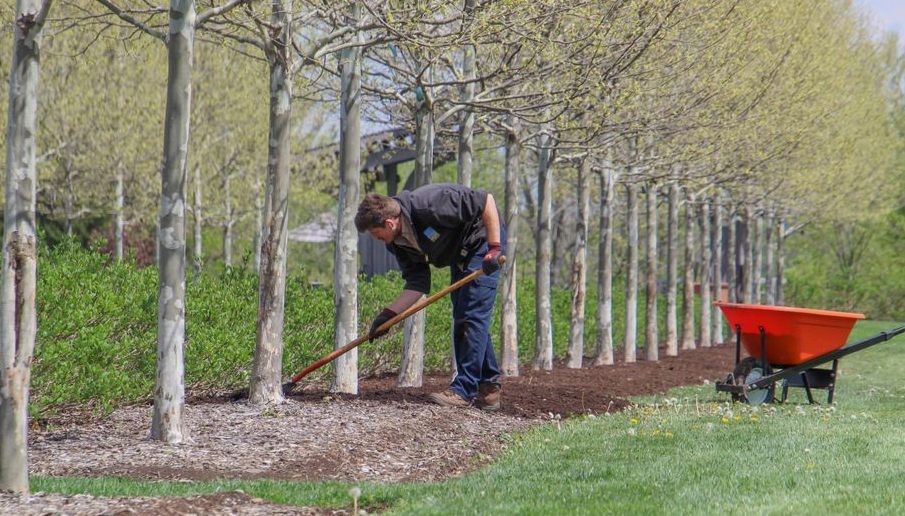
The first two summers
A newly planted tree lives on the water you give it, not on rain. The first summer decides it, and a dry stretch in July can take a tree that looked fine in April. Deep watering on a schedule beats a quick sprinkle every evening.
Keep the mulch ring maintained and pulled back off the trunk. If the tree isn't happy, we'd rather hear about it in year one than year four.
After that it's ordinary tree care: a look at the structure as the canopy fills out, and pruning when it needs it. If the trees you already have are crowded, tell us, because pruning them may be the better call than planting another.
What it runs
Planting runs $100 to $300 per tree. It's priced per tree, so six along a property line is six times the number, not one flat price.
Where you land in that range depends on how big the tree is when it goes in, how far it has to be carried from the truck to the hole, and how much has to be cut out and chipped before we can start. A single tree in an open front yard is a different job than a screen planting along a fenced back corner.
Call with the spot and roughly how many you want, and we'll tell you what it looks like before anyone picks up a shovel.
How It Works
-
Tell Us What You Need
A two-minute call is enough for us to understand the job and what it'll take.
-
Free On-Site Quote
We come out, look at the space, and confirm exactly what the job involves.
-
Clear, Written Price
You get the scope and the price in writing before any work starts. No surprises.
Some of what that looks like in the field:
- Assess the tree’s condition and structure to determine whether it can safely support climbing, rigging, and cutting loads.
- Plan the work, felling direction, drop zones, crew roles, and communication signals before cutting.
Typical Asheboro Pricing
Typical ranges, not a fixed price - the exact number is confirmed in writing before work starts.
$200–$400
Straight Answers to Common Questions
Verify insurance, ask for references, and confirm the crew will walk the site to identify power lines, lean, and hazards before cutting. Written bids should detail what is included, such as stump grinding ($90–$1,200) and debris hauling.
Tipping is optional. If the crew completes a difficult job safely and cleans up thoroughly, $20–$50 per worker is common. Many homeowners instead offer cold drinks or a positive review when the work matches the quoted $200–$5,000 price.
Obtain two or three written bids within the $200–$5,000 removal range. Ask whether stump grinding or hauling can be omitted to lower the price, or whether scheduling during slower months yields a discount. Never accept an offer that removes required safety steps.
Serving Asheboro and Nearby
Crews serve Asheboro, NC. Get My Estimate to confirm coverage for your address.
You Might Also Need
How We Do Business
- Free EstimatesThe first visit and our honest read cost you nothing.
- No-pressure guidanceYou'll hear our honest read, never a hard close.
Straight Answers
Ready when you are, request a free estimate.
Estimates · No-pressure scheduling