Start with the gear, not the price
Ask any tree company how they check their equipment. Our answer is simple. Climbing gear, cutting tools, and lift equipment get inspected before every use, and anything damaged or worn comes out of service. It doesn't go back on the truck for one more job.
A frayed rope or a chipped chain doesn't show up at the quote stage. It shows up when someone is high in the tree with a heavy limb swinging toward your gutter. A company that can describe its inspection habits plainly usually has them. If they get vague when you ask, take that as your answer.
Climbing or bucket truck: how the crew gets up there
Some trees we climb. Some we work from an aerial lift (a bucket truck). The choice depends on what's under and around the tree, whether the truck can get close, and how the wood looks.
Either way, the person aloft is secured. In a tree, that means a secure tie-in and approved fall protection. In the bucket, it means tying off at the designated anchor point, even for a short cut. If you see anyone aloft who isn't clipped in, that tells you about the company. Ask about it before you sign anything.
What to ask before you say yes
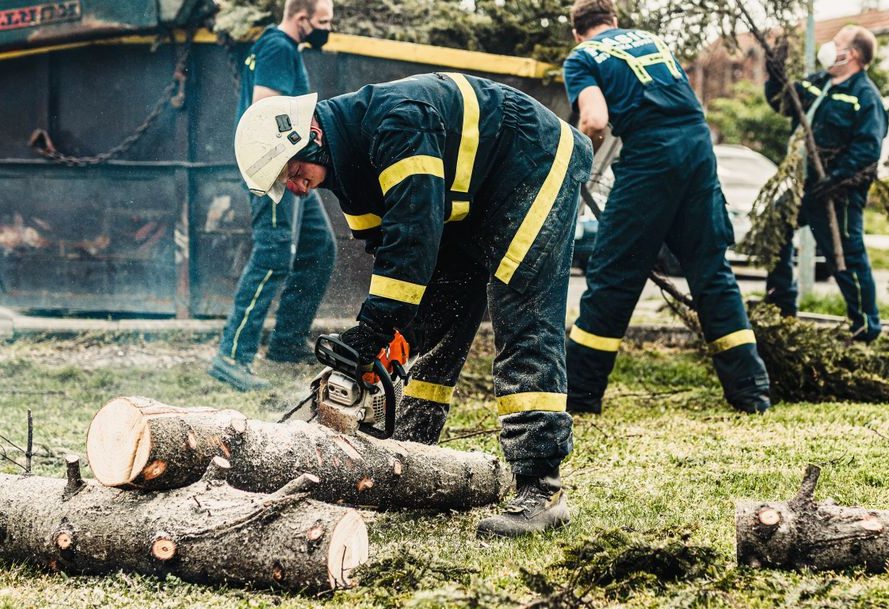
Get the scope in plain words. Is it the whole tree, a few limbs, or the stump too? Who hauls the wood and brush, and what state is the yard left in? Ask who will be on site and what equipment they'll bring. Ask to see proof of insurance rather than taking someone's word for it.
Be wary of a quote given over the phone without anyone looking at the tree. We can't price a tree we haven't seen. What drives the number is on site: how big it is, what it could land on, whether a truck can reach it, and how much has to be lowered in pieces instead of dropped. Two quotes for the same tree can differ for good reasons, so compare what each one includes, not only the total.
Stumps are a separate decision
Once the tree is down, you're left with a stump. We grind them with a stump grinder, which takes the stump below grade so you can reseed, lay sod, or plant over it. Some quotes cover the tree only and some include grinding, so settle that up front.
Tell us what you plan to put there afterward. A stump at a driveway or patio edge leaves less room to work than one in open lawn, and we can plan the grinding around what's going back in.
Check the parcel and the ground first
Before anyone plans equipment access or staging, look up the property on Randolph County's public GIS. The parcel information includes soils and floodplains, which tells you whether the spot where a heavy truck would sit is likely to be a problem. We check the same map when we set up on a lot.
Randolph County requires a special Flood Development Permit before construction starts on development in a Class A flood-hazard area. Routine tree removal on its own isn't listed as needing it. If your parcel shows floodplain and your project goes beyond the tree, call the county before work begins. Winter freezes here also bring some freeze/thaw movement, so after a cold snap we look at the ground again before staging anything heavy on it.
Get in touch
Tell us what the tree is doing and where it stands: leaning, dead limbs, too close to the house, or just in the way. A few photos help, along with a note on how a truck could reach it. We'll come out, look at the tree and the ground around it, and give you a straight scope and a straight price. Call us and we'll set up a time to see it.
How It Works
-
Tell Us What You Need
A two-minute call is enough for us to understand the job and what it'll take.
-
Free On-Site Quote
We come out, look at the space, and confirm exactly what the job involves.
-
Clear, Written Price
You get the scope and the price in writing before any work starts. No surprises.
Some of what that looks like in the field:
- Plan the work, felling direction, drop zones, crew roles, and communication signals before cutting.
- Treat overhead power lines as energized and maintain required clearance; contact the utility if work cannot be done safely at that distance.
Typical Asheboro Pricing
Typical ranges, not a fixed price - the exact number is confirmed in writing before work starts.
$90–$1200
$200–$400
Straight Answers to Common Questions
Demand often drops in late fall and winter, which can lower rates within the normal $200–$5,000 range. Mild weather also lets crews work safely without ice or summer foliage blocking access. Booking during slower months may reduce wait times as well.
Tipping is optional. If the crew completes a difficult job safely and cleans up thoroughly, $20–$50 per worker is common. Many homeowners instead offer cold drinks or a positive review when the work matches the quoted $200–$5,000 price.
Obtain two or three written bids within the $200–$5,000 removal range. Ask whether stump grinding or hauling can be omitted to lower the price, or whether scheduling during slower months yields a discount. Never accept an offer that removes required safety steps.
Tree removal typically ranges from $200 to $5,000. Price depends on tree height, diameter, location, lean, nearby structures or power lines, and whether stump grinding or hauling is included. Larger or more complex jobs near homes or utilities require more crew, rigging, and equipment, which raises the cost.
A 40-foot tree usually falls in the middle of the $200–$5,000 removal range. Factors that increase price include trunk diameter, branch spread, proximity to buildings or wires, and whether the crew must climb or use a crane. Stump removal adds $90–$1,200 extra.
Most tree removal is paid work costing $200–$5,000. Free service for seniors is uncommon and usually limited to local nonprofit programs, utility assistance, or municipal grants when a tree poses a documented safety hazard. Homeowners should check city or county resources directly.
Serving Asheboro and Nearby
Crews serve Asheboro, NC. Get My Estimate to confirm coverage for your address.
You Might Also Need
How We Do Business
- Free EstimatesThe first visit and our honest read cost you nothing.
- Straight answers, no sales pitchYou'll hear what we'd do and why, the decision stays yours.
Fast Scheduling
Ready when you are, request a free estimate.
Estimates · No-pressure scheduling